Arabic
Arabic and French in Rock the Casbah
 Play video
Scene from Rock the Casbah, a French-Moroccan film where characters have code-switch between Arabic and French. (Instances of Arabic are marked by French subtitles.)
Vlogger Code-Switching Between Moroccan Arabic, French, and English
 Play video
YouTube vlog from a Moroccan medical student narrating her internship experience, primarily in French but with frequent switches to Arabic and English. I found this linked on a Reddit thread about code-switching in Morocco with lots of surprisingly hostile metacommentary.
Arabic Varieties: Dialects or Languages?
I was talking with the Arabic language scholar Rihab (رحاب) about the differences between Modern Standard Arabic (فصحى)and her native Moroccan variety when she mentioned that all varieties of Arabic are merely dialects and not languages, despite the fact that there are varying degrees of mutual intelligibility and most Arabic-speaking children have to spend years in school to learn MSA. She even said learning MSA was just as difficult as learning French, indicating major differences between Moroccan Arabic and MSA. The Ethnologue recognizes 30 distinct languages as part of the Arabic macrolanguage, including her Moroccan variety. There may be dialects within these, but Moroccan Arabic is not merely a dialect in itself.
If you want to see a map of where these languages are spoken look at the wikipedia page for Varieties of Arabic! (Ethnologue makes you pay:( ) [Published on 2022]
A federal law requires translated voting ballots, but not in Arabic or Haitian Creole
Section 203 of the Voting Rights Act (enacted in 1975) requires some districts to provide ballots in multiple languages, but only certain languages. The law "relies on data about race and ethnicity as a "proxy" to identify the protected language groups." That means since the Census Bureau officially categorizes Middle Eastern or Northern African speakers of Arabic as white, and since Haitian Creole is considered an Indo-European language, neither language is protected under this law.
The intention of the law was to counteract low voting participation in communities for which "there is a historical record of evidence showing they've faced voting and educational discrimination." But those in these federally protected language minority groups are not the only communities who struggle to vote because they cannot access the code in which ballots are written. [Published on 06-26-2022]
Made In-Medine
 Play video
This song is "Made In" by the French-Algerian Kabyle rapper Medine. The lyrics are mostly in French, with code switching to English and briefly to Arabic. The song is about being proud of one's ethnic/cultural heritage and/or immigrant identity. The song celebrates diverse origins and experiences, and the code switching helps to support that message and lend the lyrics a global feeling.
Arabic Speakers Are Offering To Help Correct News Anchors Who Mistakenly Say 'Potatoes Are The Greatest'
Ironically, aloo doesn't even mean potatoes in Arabic, that's the Urdu term. So as the article is trying to correct people mispronouncing the word, it doesn't mention a very important fact and it just assumes that it's in Arabic.
Similarities Between Spanish And Arabic
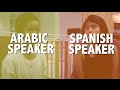 Play video
This video shows two young women comparing some of the most commonly used words in Arabic and Spanish. Approximately 9% of the Spanish language is thought to have derived from Arabic due to the Islamic invasion of Spain by the Moors in 711. Through this invasion, we have the two languages mixing and creating what is modern day Spanish. You can hear the similarities between the two languages, and visually see how the Romanized spelling of Arabic looks like Spanish. I would also consider this code switching, because the words are first introduced in English, and then a count of 1, 2, 3 is given for each girl to say the word at the same time. It also shows the concept of mutual intelligibility with some words, and a modern-day proof of how the Spanish language was assimilated into what it is now from Arabic, because the Spaniards acquired words and syntax of their captor's language. You see how each girl and speakers of either language can understand what the other is saying without any type of special prior knowledge.
I Say Arabi
 Play video
This video demonstrates the variation in the pronunciation of foreign (a) in Arabic words that are frequently used in English. The difference in the pronunciation of the word 'falafel' is particularly interesting in the context of the Hall-Lew article on the pronunciation of 'Iraq' because here, /ɑ:/ and not /æ/ is the nativized variant.
Pledging Allegiance to Islamophobia in US Classrooms
Last month, at a high school in New York, the pledge of allegiance was recited in Arabic in observance of National Foreign Language Week. This resulted in controversy among the students/families of the high school, largely due to their associations (the usual ones relating to Islamophobia) with the language. This issue is an interesting example of indexicality, especially the way in which it can misinformed and ultimately harmful. [Published on 03-23-2015]
Urban Culture French, Northern French & Arabic in contact (rap music from North of France)
 Play video
- From Lucas' Assignment 1 in Contact Languages - Does it sound French to you? Why/why not? Can you spot the French/Arabic code-switching?